
Chris Barletta
From behind, this is a swing with a genuinely good athletic setup and a finish that holds — but the middle is run by the arms and the trail side. At address the hip hinge, knee flex and hanging arms are close to textbook and the stance is driver-wide, which is why the club gets away on plane early. The problem shows up at the top: the shaft climbs to a steep, near-upright position over the left edge of the frame while the trail hip has barely gained depth, so the club is lifted rather than coiled. From there the transition is an upper-body move — the shoulders start the club down before pressure clearly moves to the lead foot — and by frame 17 the trail heel is still low and the body is finishing the job with arms and hands. Credit where due: the strike is committed, not steered, and the finish at frames 21-23 is tall, balanced and held. Fix the depth of the backswing pivot and the sequence in transition, and this swing gains speed without you swinging any harder.
Swing video
What’s working
Address posture is genuinely good: about 30-35 degrees of hip hinge, real knee flex, weight over the middle of the foot and the arms hanging free under the shoulders with a driver-width stance.
The strike is committed and accelerating rather than guided — the club is a blur through frames 16-18 and the release is full, which is real speed evidence and worth protecting.
The finish at frames 21-23 is tall, on the lead leg, chest to the target and held still for a beat with no stumble or step.
Highest priorities
- 1
The backswing is an arm lift, not a pivot: at frame 15-16 the shaft is nearly upright and the trail hip has barely worked behind you, so the top is high but shallow on coil — get the chest turning and the trail hip going back and around before the hands go up.
- 2
Transition starts from the top down. Between frames 15 and 17 the shoulders and arms drive the change of direction with no clear pressure move into the lead foot first, which steepens the shaft and costs the ground force that a driver lives on.
- 3
The trail side never fully releases through impact — at frame 17 the trail heel is still hugging the ground and the hips are only slightly open, so the arms are delivering most of the strike instead of rotation.
Four positions that shape the swing.
Annotations point only to features visible in the selected frames.
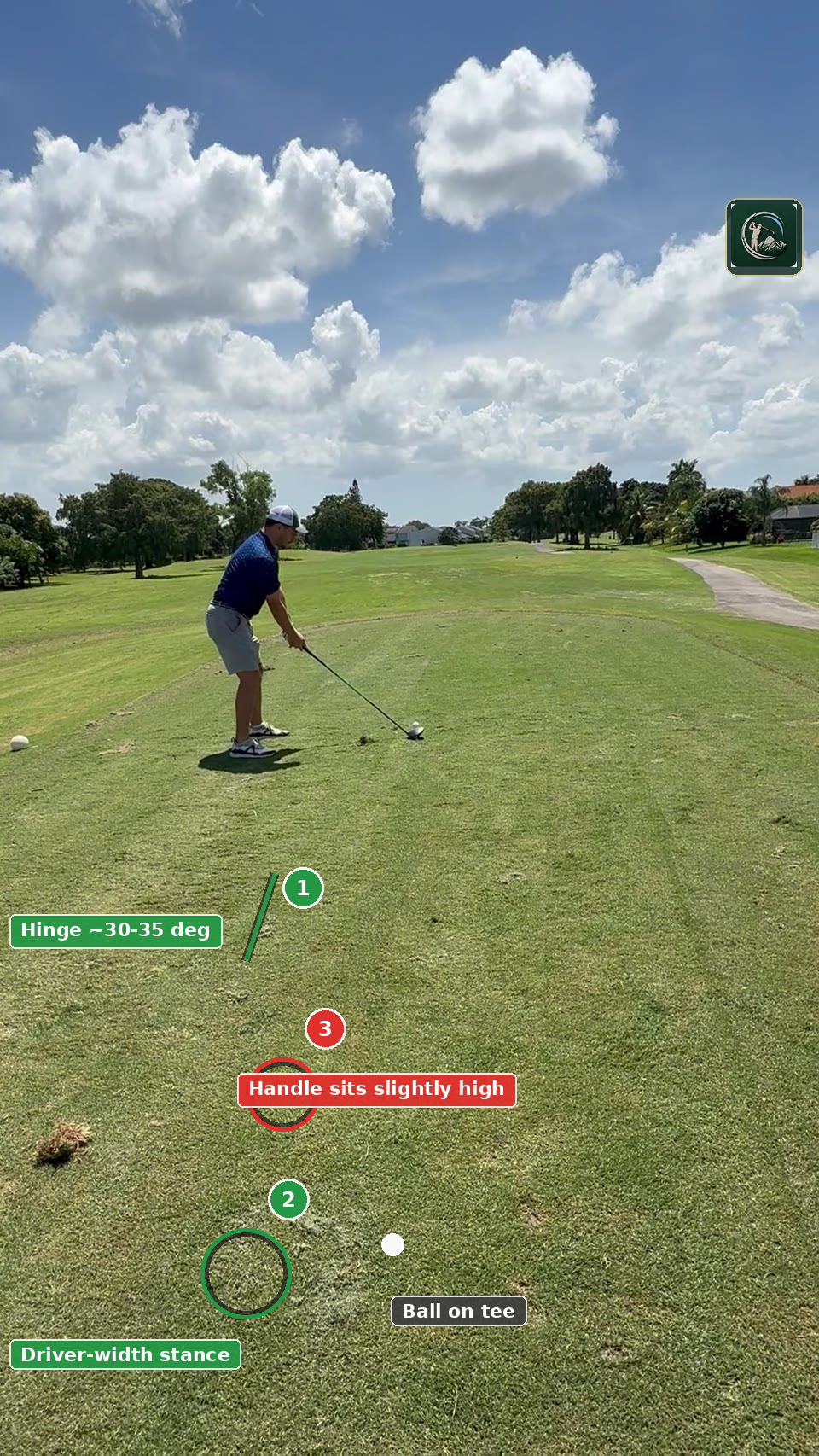 01
Address / setup
- 1hinge ~30-35 deg
The forward bend comes from the hip joints with the chest over the toes and the back long — this is a tour-quality hinge and the reason the club can swing on plane early. Keep it exactly as it is.
- 2driver-width stance
Insteps are at least shoulder width with real knee flex and pressure through the middle of the foot — the right base for a driver. Nothing to change here.
- 3handle sits slightly high
The arms hang close to under the shoulders but the handle is propped a touch and the trail elbow is straight rather than soft and connected. Let the trail elbow fold in against the ribcage so the hands drop and hang free.
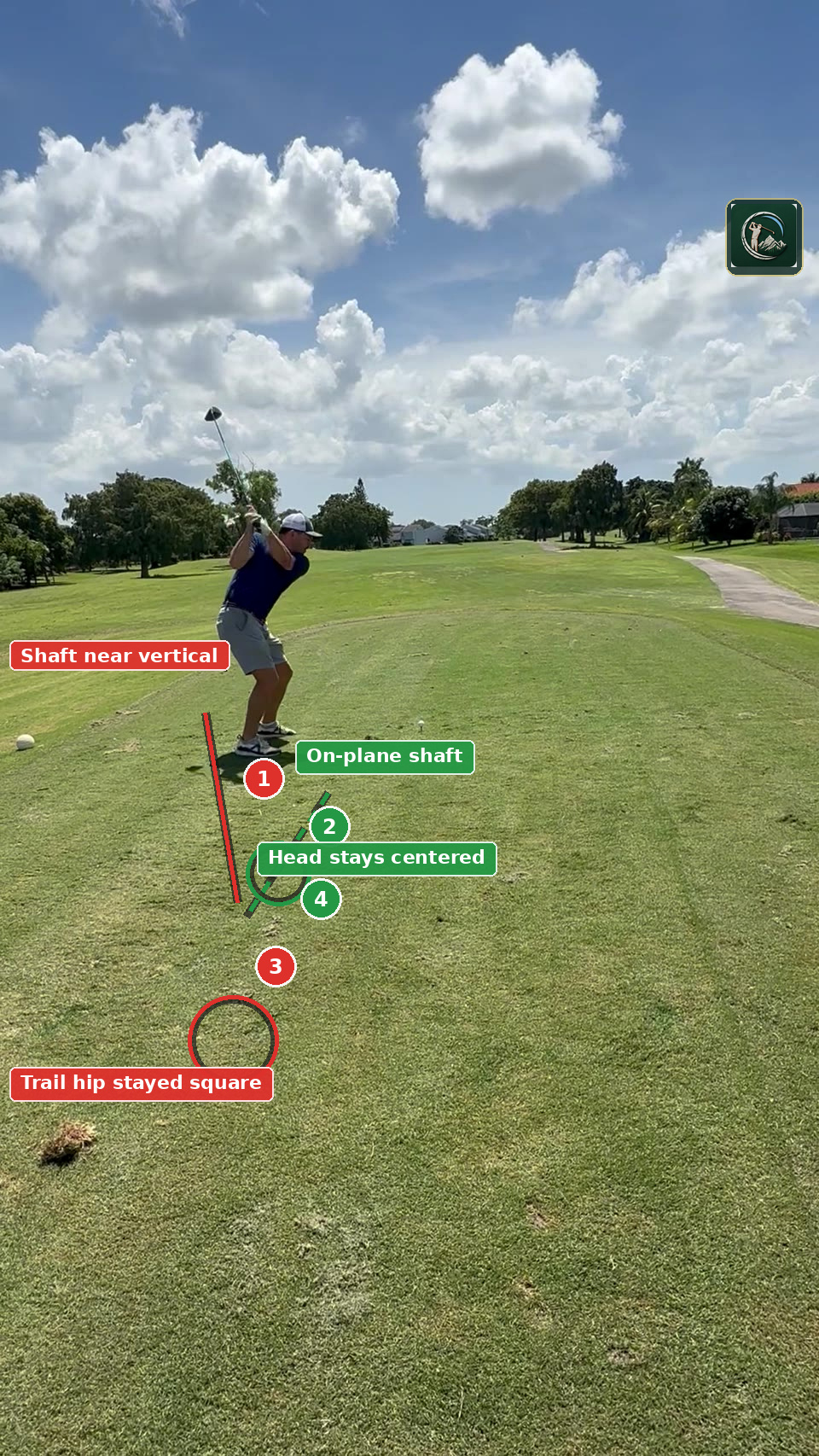 02
Top of backswing
- 1shaft near vertical
At the top the shaft stands almost straight up instead of lying halfway between vertical and flat — that is a lift with the hands, not a coil. It forces the club to steepen coming down and hands the strike to your arms.
- 2target: on-plane shaft
Aim the shaft here — angled back over the trail shoulder on a rounded plane. You get there by turning the chest and trail hip more, not by moving the hands.
- 3trail hip stayed square
The belt line has barely changed from address — the trail hip has not worked behind you, so there is very little coil under that high top position. Turn the trail pocket back and away and the depth will come.
- 4head stays centered
No sway off the ball and no dip or rise out of posture through the backswing — a solid base to build the better pivot on.
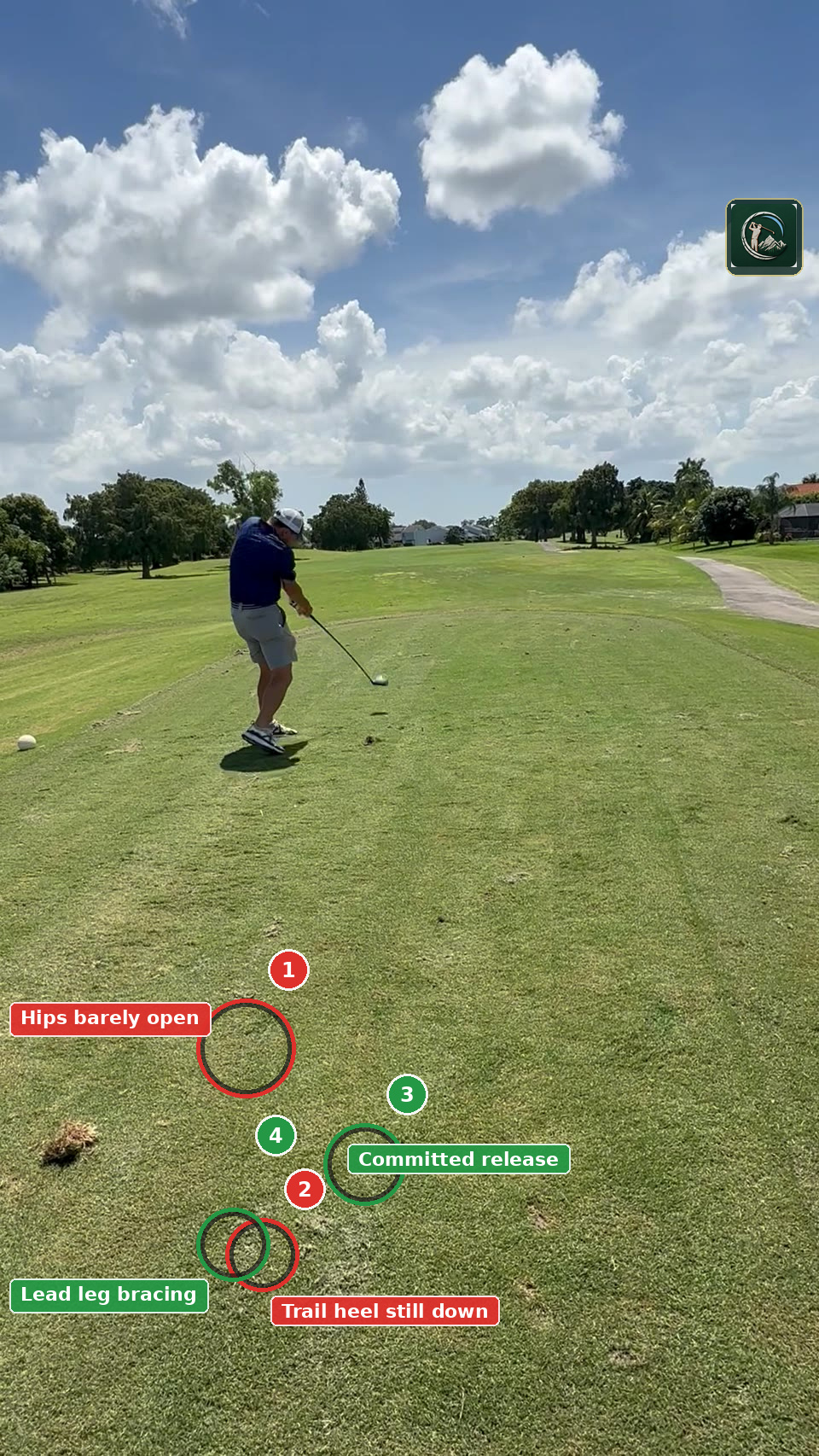 03
Impact
- 1hips barely open
At the strike the belt line is only slightly open to the target with the chest right behind it. Square hips mean the arms have to deliver everything — clear the lead hip earlier and the club arrives with rotation behind it.
- 2trail heel still down
The trail heel is still hugging the ground with the ball already gone. Rotation should be pulling that heel up before impact; when it stays planted the trail side blocks the turn.
- 3committed release
The club is a blur through the strike with a full extension of the arms — this is real speed, not a steered pass. Keep the commitment and add the sequence underneath it.
- 4lead leg bracing
Weight has moved to the lead side and the lead leg is taking the load rather than collapsing — post it harder and straighter and it becomes a true pivot point.
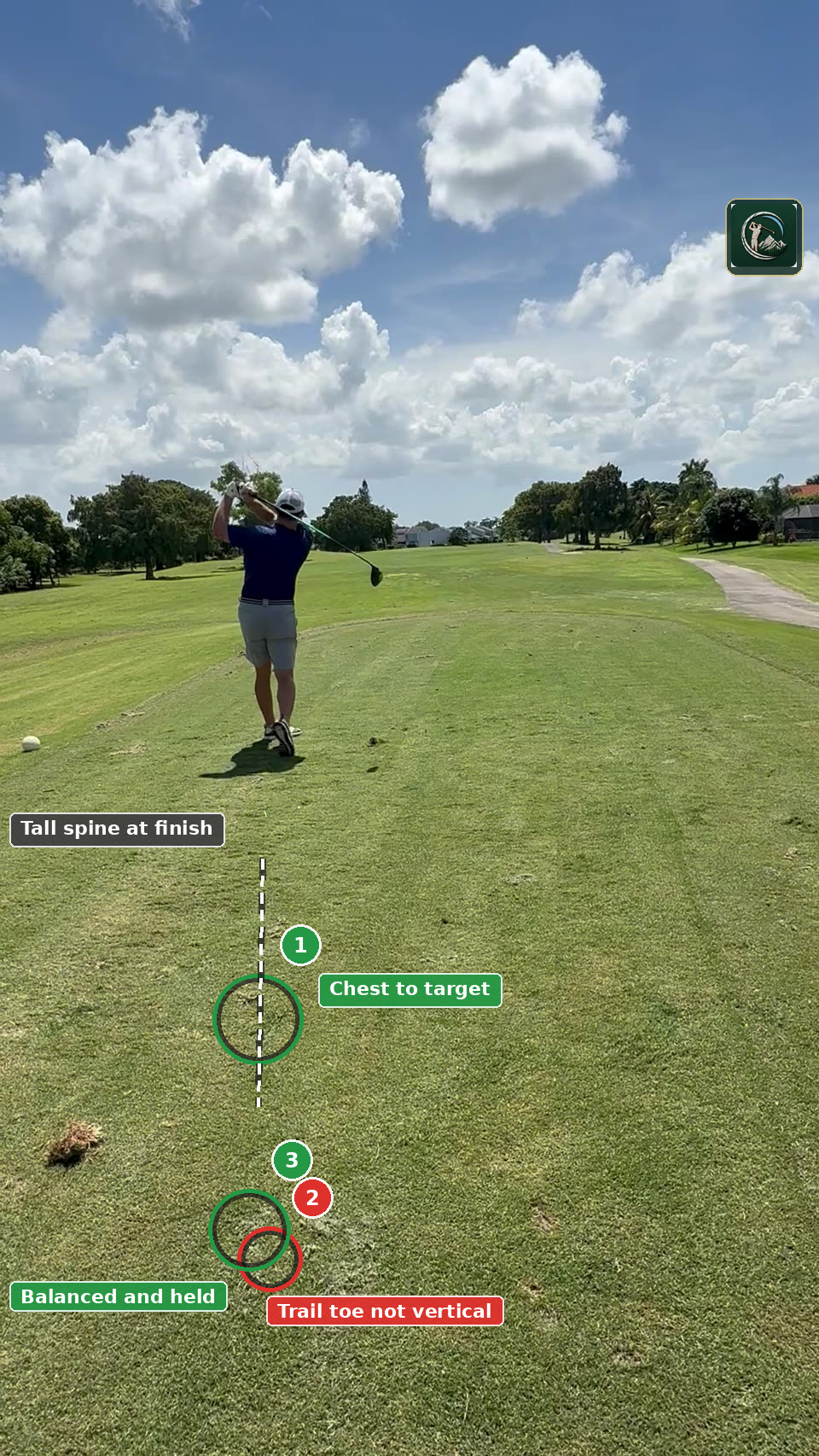 04
Finish
- 1chest to target
The body has unwound so the chest and belt face down the fairway — the rotation you need at impact is clearly available to you, it just arrives too late.
- 2trail toe not vertical
The trail foot has released but the toe is not fully rolled onto its tip — the tail end of that heel staying down through impact. A complete release of the trail foot is the sign the hips finished clearing.
- 3balanced and held
Weight is stacked on the lead leg and the position is held still across three frames with no stumble or step — a finish this quiet says the effort matched the swing.
The complete read.
Each checkpoint is scored from one to five based on visible swing positions.
Setup
11 / 15The best part of the swing. At frame 8 the forward bend is roughly 30-35 degrees out of the hips with the chest over the toes, the stance is comfortably driver-width, and the knees hold athletic flex with pressure through the middle of the foot. The arms hang close to under the shoulders but the handle sits fractionally high and the trail arm looks a touch reached across — soften that and the hands sit even quieter.
Feet, knees and hips read as one line pointing up the fairway from this angle, and the shoulders sit close to that line — close enough to work, but the trail shoulder looks marginally high and out rather than clearly under. Ball position and spine tilt away from the target cannot be judged from behind. The setup itself is still and organized: eleven frames at address with no drifting feet is a genuinely settled pre-shot.
The hands look unified on the handle with no visible separation, and the forearms stay reasonably soft, though the trail elbow sits a little straight rather than folded and connected to the chest. Hands hang about the right distance from the thighs — not crowded, not reaching. Nothing tense or fidgety across frames 0-11; the grip pressure looks calm and repeated, which is worth keeping.
Backswing
7 / 15By frame 12 the chest and arms have moved away together reasonably well and the lower body has stayed braced without a sway off the ball. The clubhead is already high and out of frame at the sampled interval, so early face-to-spine match cannot be judged. The wrist set is the issue — the club is already up near y=490 with the hands only at chest height in frame 12, which is an abrupt early hinge rather than a progressive set.
This is the root of the swing's problems. At frames 13-15 the shoulders turn well short of a full 80-90 degree coil and, more importantly, the trail hip stays close to where it started rather than working behind you and gaining depth — the belt line barely changes from address. The head and spine do stay centered, which is a credit. But the arms outrun the body: the club is lifted upward instead of swinging around the chest, so the top looks big while the coil underneath it is small.
At frame 15 the shaft stands almost vertical over the left of the frame instead of lying on a rounded plane halfway between vertical and flat — that is the signature of an arm lift. The hands finish high but shallow, in front of rather than behind the trail shoulder, so there is no width or depth to trade for speed. The lead arm keeps its structure and the wrists support the club, which is why the club still gets back to the ball. The top is not loaded from the ground; it is stacked in the arms,
Downswing
5 / 10Between frames 15 and 16 the club comes down before there is any visible pressure change into the lead foot — the lower body looks essentially where it was at the top while the arms and shoulders begin the move. That order steepens the shaft rather than shallowing it, which is exactly what you would predict from an upright top. Posture and head height do hold through the change of direction with no early stand-up, so the fix is sequence, not stability.
The pelvis is not leading. By frame 17 the hips are only slightly open while the chest has already come along with them, so there is no separation to hit against. The trail heel is still low and largely planted through the strike — rotation is not pulling it up, the arms are just swinging past it. The wrist angles are held reasonably deep into delivery and rotation does keep flowing rather than stalling into a flip, which is why the strike still has speed.
Impact & Finish
7 / 10At frame 17 the hips are only marginally open to the target with the chest close behind them — the body is square when it should be clearing, which forces the arms to deliver everything. Weight has moved to the lead side and the lead leg is bracing, though not fully posted. Head position behind the ball and shaft lean at the strike cannot be judged from this down-the-line angle; get a face-on clip for those.
The finish is a real strength. By frame 22 the chest and belt are pointing down the fairway, though the hips could clear another few degrees to fully unwind. Weight is on the lead leg with the trail foot up, but the trail toe is not quite vertical — a remnant of that heel staying down through impact. The balance is genuinely good: the position is arrived at cleanly and held still across frames 21-23, and the whole motion looks committed and unhurried rather than lunged at.
Three drills.
One direction.
Build the motion slowly, then add speed only when it stays organized.
Replace the arm lift with a real pivot by teaching the trail hip to gain depth instead of staying square.
Trail-hip-back turn against a chair
- Set up in your address posture with a chair back or alignment stick touching the outside of your trail hip.
- Make slow backswings and turn the trail hip back and away so it stays in contact with the chair while your lead shoulder works under your chin.
- Once you feel the hip go back rather than spin flat, add the arms — but let the hands only rise as high as the turn earns.
- Do 15 slow reps, then hit 5 half-speed driver shots keeping that same feel.
Get pressure into the lead foot before the arms start down so the sequence runs ground-up instead of top-down.
Step-through transition
- Address the ball with your feet together, ball off the lead foot.
- Start the backswing and, as the club reaches the top, step your lead foot out to full width and plant it.
- Let that plant — not your shoulders — pull the club down; you should feel the arms lag behind the step.
- Start at half speed with a 7-iron, then move to driver off a tee once the timing is automatic.
Get the trail side turning through the strike so rotation, not the arms, delivers the club.
Trail-heel release check
- Place a tee or ball marker under the trail heel at address so you can feel when it stays down.
- Make three-quarter swings and make it a rule that the trail heel is off the ground before the club reaches the ball.
- Hold the finish for three full seconds with the trail toe pointing straight down and the belt buckle facing the target.
- Film it down-the-line and compare the trail heel at your impact frame to this clip's frame 17.