
Tiger Woods
This is an elite-level motion caught from behind: the club works on a beautifully rounded plane to the top in frame 2, the transition is led by the lower body with pressure already into the lead foot by frame 3, and the strike at frame 4 shows the trail heel released, the hips clearly open, and the head still back behind the ball. The tempo read off the frame indices - roughly two frames up, one and a bit down - tells you the speed is being built by sequence rather than by hitting from the top. What is genuinely visible as less than perfect is the finish: from frames 10-13 the body keeps working slightly left of the target line and the hands stay a touch low and behind the head rather than finishing high and fully wrapped, and the golfer walks out of the pose by frame 13 rather than holding it a full beat. The camera hides the grip and true alignment, so those get graded only on what is defensible.
Swing video
What’s working
Top of the swing (frame 2) is textbook: the shaft sits on a rounded plane roughly halfway between vertical and flat, hands high behind the trail shoulder, lead arm keeping its structure - nothing is lifted or collapsed.
Transition and sequence are tour standard - by frame 3 the hands are only hip high while the hips have already opened, and the trail heel is off the ground at frame 4, which is the ground leading the arms rather than the other way round.
Impact alignments at frame 4: lead leg braced, hips open, head clearly behind the ball, and the divot spray forward of the low point - the shaft is delivering, not scooping.
Highest priorities
- 1
Finish the swing all the way through instead of easing off after the ball is gone - in frames 10-13 the hands hang low around chest height behind the head rather than arriving high and fully wrapped over the lead shoulder.
- 2
Hold the finish for a full beat. The pose at frame 11 is balanced, but by frame 13 the trail foot is already coming down and the golfer is walking off; the last thing the body learns is what it does last.
- 3
Let the chest keep turning to face the target rather than stopping slightly left of it - at frames 11-12 the belt buckle is still short of full clearance, which is a small brake on an otherwise complete release.
Four positions that shape the swing.
Annotations point only to features visible in the selected frames.
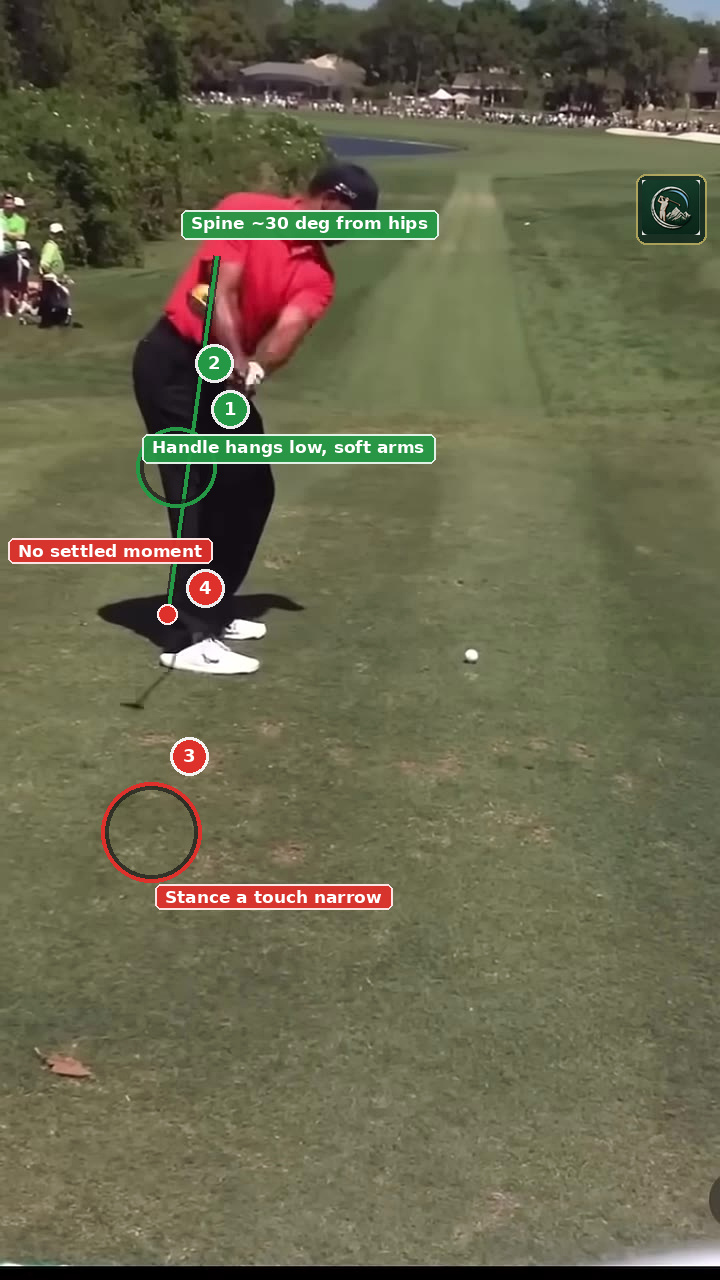 01
Address / setup
- 1spine ~30 deg from hips
The forward bend comes from the hip joints with the chest over the toes - this is the posture that lets the club work on plane all the way to the top. Nothing to change here.
- 2handle hangs low, soft arms
The hands hang directly beneath the shoulders with comfortable space from the thighs and the elbows soft in front of the chest - no reaching or propping, which is why the takeaway can go one-piece.
- 3stance a touch narrow
For the club in hand the insteps sit slightly inside where a coach would want them, which is the one measurable thing at setup - widen half a shoe width for a firmer base to turn against.
- 4no settled moment
This first frame already shows the club moving - there is no still, organized beat captured before the takeaway. Build a visible pause so the swing starts from stillness rather than drift.
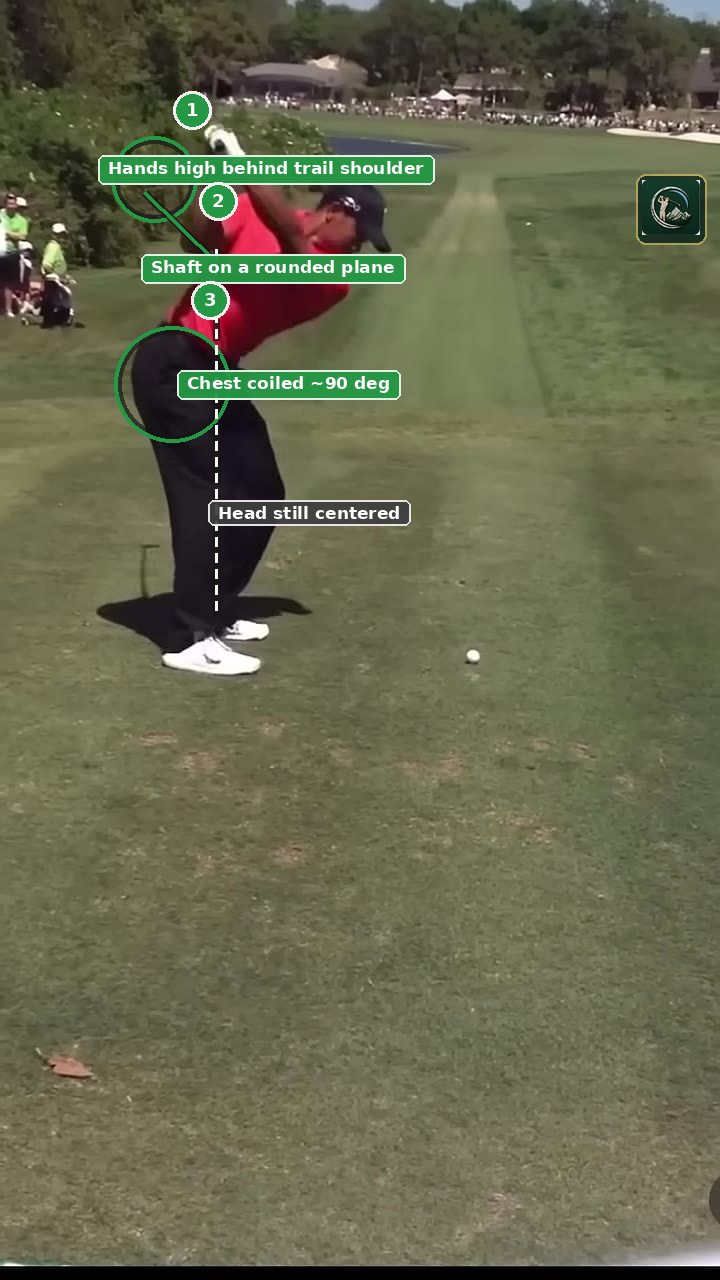 02
Top of backswing
- 1hands high behind trail shoulder
Real width and depth at the top with the hands over and behind the trail shoulder - this is a loaded position, not a parked one, and it is what lets the ground start the downswing.
- 2shaft on a rounded plane
The shaft lies roughly halfway between vertical and flat rather than pointing skyward, so nothing was lifted by the hands. Keep this exact look.
- 3chest coiled ~90 deg
The chest has turned close to 90 degrees against a braced lower body with the trail hip clearly deeper than address - the arms did not do this on their own.
- head still centered
Head and spine sit exactly where they were at frame 0 - no slide off the ball, no dip, no rise. That stability is the whole reason the strike can be this precise.
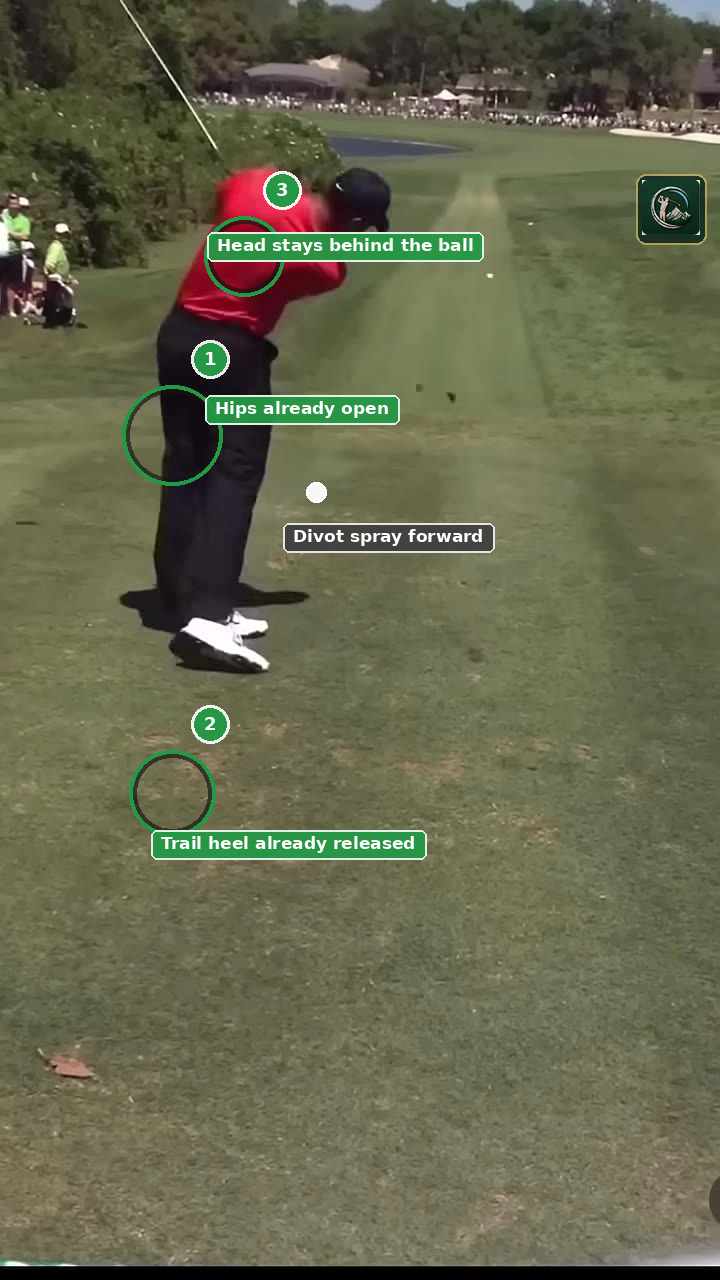 03
Impact
- 1hips already open
At the strike the pelvis is clearly rotated open toward the target while the chest is only starting to follow - the classic sign that the ground, not the arms, is delivering the club.
- 2trail heel already released
The trail heel is off the turf at the moment of the strike because rotation is pulling it, not because it was lifted. That is genuine sequencing, and it is why the speed arrives at the ball rather than before it.
- 3head stays behind the ball
Spine tilt from address is retained through impact with no stand-up and no slide toward the target - the low point stays forward of the ball, which is why the turf spray is out in front.
- divot spray forward
Turf debris in the air ahead of the ball position confirms a descending, ball-then-turf strike with the hands leading the clubhead.
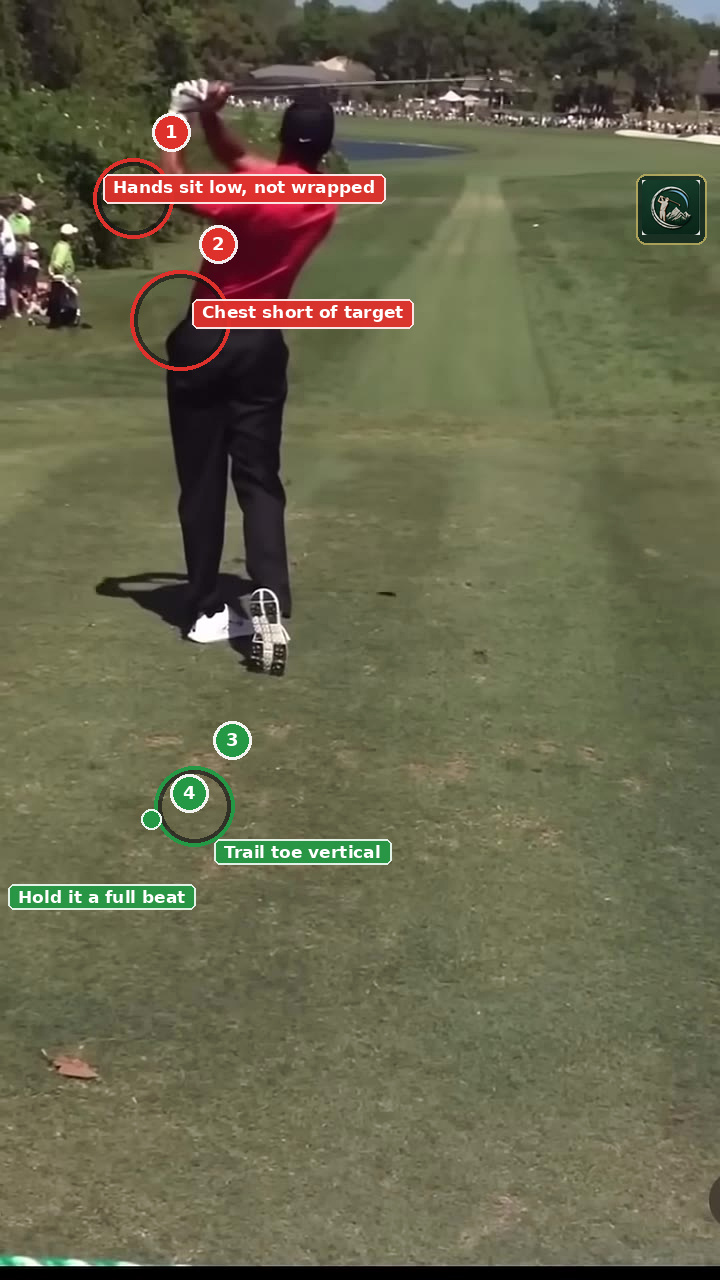 04
Finish
- 1hands sit low, not wrapped
The hands hang around head height behind the neck rather than finishing high and wrapped over the lead shoulder - the swing eases off after the ball is gone. Work toward the shaft resting across the back of the neck with the hands over the lead ear.
- 2chest short of target
The belt buckle and chest stop slightly short of facing the target, so the release is not quite complete. Let the rotation keep running after contact until you can see the whole chest from behind.
- 3trail toe vertical
Weight is entirely on the lead leg with the trail foot released onto a vertical toe - exactly what a finish should look like from the ground up.
- 4hold it a full beat
By frame 13 this foot is already back down and the golfer is walking off. Freeze this exact position for a three-count on every practice ball - the last thing the body does is the thing it remembers.
The complete read.
Each checkpoint is scored from one to five based on visible swing positions.
Setup
11 / 15Frame 0 shows a forward bend of roughly 30 degrees coming cleanly out of the hips with the chest over the toes and the handle hanging low under the shoulders - nothing propped or reaching. Knees carry real athletic flex with pressure looking mid-foot. Stance looks slightly narrow for the club in hand from this angle, which is the one thing a coach would measure rather than admire.
From directly behind, the feet and hips read as set on one coherent line toward the fairway, but shoulder line and ball position simply cannot be judged from this camera and are left unscored. What is visible is that frame 0 is already in motion - there is no still, organized moment captured before the takeaway, so the settled-setup checkpoint gets marked down on the evidence available.
Grip detail and clubface are hidden behind the body from this angle. What is clear is that the forearms stay soft and connected in front of the chest and the hands hang with comfortable space below the chin - no crowding, no reaching, no locked elbows. Those two are tour quality; the rest the camera won't let me grade.
Backswing
14 / 15Between frames 0 and 1 the club, hands, arms and chest move away as one unit with no hands-first pickup, and the lower body stays braced with zero sway off the ball. The wrists set progressively as the arms rise rather than snapping. The one thing the down-the-line view suggests is the clubhead working just slightly inside the hands early rather than staying visibly outside them.
Frame 2 shows the chest coiled close to 90 degrees against a braced lower body with the trail hip clearly turned behind the golfer - this is not an arms-only backswing. The head and spine stay dead centered from frame 0 to frame 2 with no dip, slide, or rise. The arms stay in sync with the turn so the club works around the body rather than being lifted.
The shaft at frame 2 lies on a rounded plane roughly halfway between vertical and flat, hands high over the trail shoulder with genuine width and depth behind the chest. The lead arm holds its structure and the wrists support the club without collapse. It looks loaded rather than parked - a top position from which the ground can start the downswing, and it does.
Downswing
10 / 10By frame 3 the hands are still only hip high while the lower body has already changed direction and pressure has moved into the lead foot - that is the lower body initiating, not a shoulder spin from the top. The shaft holds and shallows rather than steepening, and the head height at frame 3 matches frame 0 exactly, so there is no early stand-up or dive.
The pelvis clearly leads: at frame 3 the hips are opening while the chest is still square. The trail heel is already releasing by frame 4 as rotation pulls it, wrist angles are visibly retained into the delivery zone, and rotation keeps flowing through frames 4-6 with no stall or hand flip to rescue the strike. Two frames up, roughly one down - the speed is built by sequence.
Impact & Finish
9 / 10Frame 4 catches the strike: hips visibly open with the chest starting to follow, weight stacked on a bracing lead leg, head still behind the ball with the spine tilt from address retained, and the turf spray thrown forward of the ball position. Nothing here is scooped or saved - the hands are delivering the shaft, and the body is still turning through it.
The trail foot releases beautifully onto a vertical toe and the whole motion reads unhurried with effort matching result. But at frames 10-12 the chest and belt buckle stop slightly short of facing the target and the hands hang low behind the head rather than finishing high and wrapped, and by frame 13 the trail foot is already dropping and the golfer is walking off - the pose is never held for a full beat. Finish the swing, then hold it.
Three drills.
One direction.
Build the motion slowly, then add speed only when it stays organized.
Turn a good-looking follow-through into a fully completed, held finish so the body never learns to ease off after the ball.
Hold the Photo Finish
- Hit half-speed wedges and freeze the finish for a slow three-count before you look up at the ball.
- In the hold, check three things: belt buckle at the target, hands above the lead shoulder, all weight on the lead leg with the trail toe vertical.
- Build to full swings, keeping the same three-count hold on every ball.
- If you have to shuffle to hold it, the swing was faster than your balance - back off one club.
Get the arms to finish high and wrapped over the lead shoulder rather than hanging low behind the head.
Wrap the Hands High
- Make slow rehearsal swings and physically place the shaft across the back of your neck at the end of each one.
- Hit shots trying to feel the trail arm end up above the lead arm, hands over the lead ear.
- Alternate one rehearsal, one ball, keeping the finish height identical between the two.
Keep the chest rotating past the strike so the finish faces the target instead of stopping slightly left of it.
Chest to the Target Turn-Through
- Set an alignment stick in the ground a step in front of your lead foot pointing at the target.
- Hit three-quarter shots and end every one with your sternum pointing down that stick, not left of it.
- Have a partner or your camera stand behind you: at the finish they should see your whole chest, not your side.