
LRG
You swing a driver with genuine commitment — the strike frames are blurred, the arms are extended through the ball and the finish is held on a stacked lead leg with the trail toe released. That is real, and it is the part worth protecting. The cost is in how the club gets to the top: the hands lift the club almost vertically (frames 6-9) while the chest coils only partway and the hips stay close to square, so at the top you have height instead of depth and very little stored coil. From a steep, shallow-turn top the downswing has to be rescued with speed and arms, and at impact (frame 11) the head has dropped and the upper body has moved out toward the ball rather than the hips clearing ahead of the chest. Fix the pivot — more chest turn, more trail-hip depth, hands wider and behind you — and the good things you already do through the ball will start paying off in centeredness of contact instead of just effort.
Swing video
What’s working
Genuinely committed acceleration through the ball — the strike frames (11-13) show heavy blur and full arm extension, not a guided pass at the ball.
The finish is stacked and held: by frames 17-19 the weight is entirely on the lead leg, the trail foot is up on the toe, and you hold the position still for a beat.
Setup is calm and organized — hands hang under the chin, grip looks unified, and there is a genuine still moment at frames 0-2 before the club moves.
Highest priorities
- 1
Turn the chest and trail hip instead of lifting the arms: at frames 6-9 the shaft is nearly vertical and the hands never get behind the trail shoulder, so there is almost no coil to release.
- 2
Stop the downward/outward move of the head into the strike — at frame 11 the head has dropped and the upper body has drifted toward the ball line, which is why the arms have to save the strike.
- 3
Get the hips open at impact. The pelvis is barely ahead of the chest at frame 11; the delivery is arm-dominated because the body never leads.
Four positions that shape the swing.
Annotations point only to features visible in the selected frames.
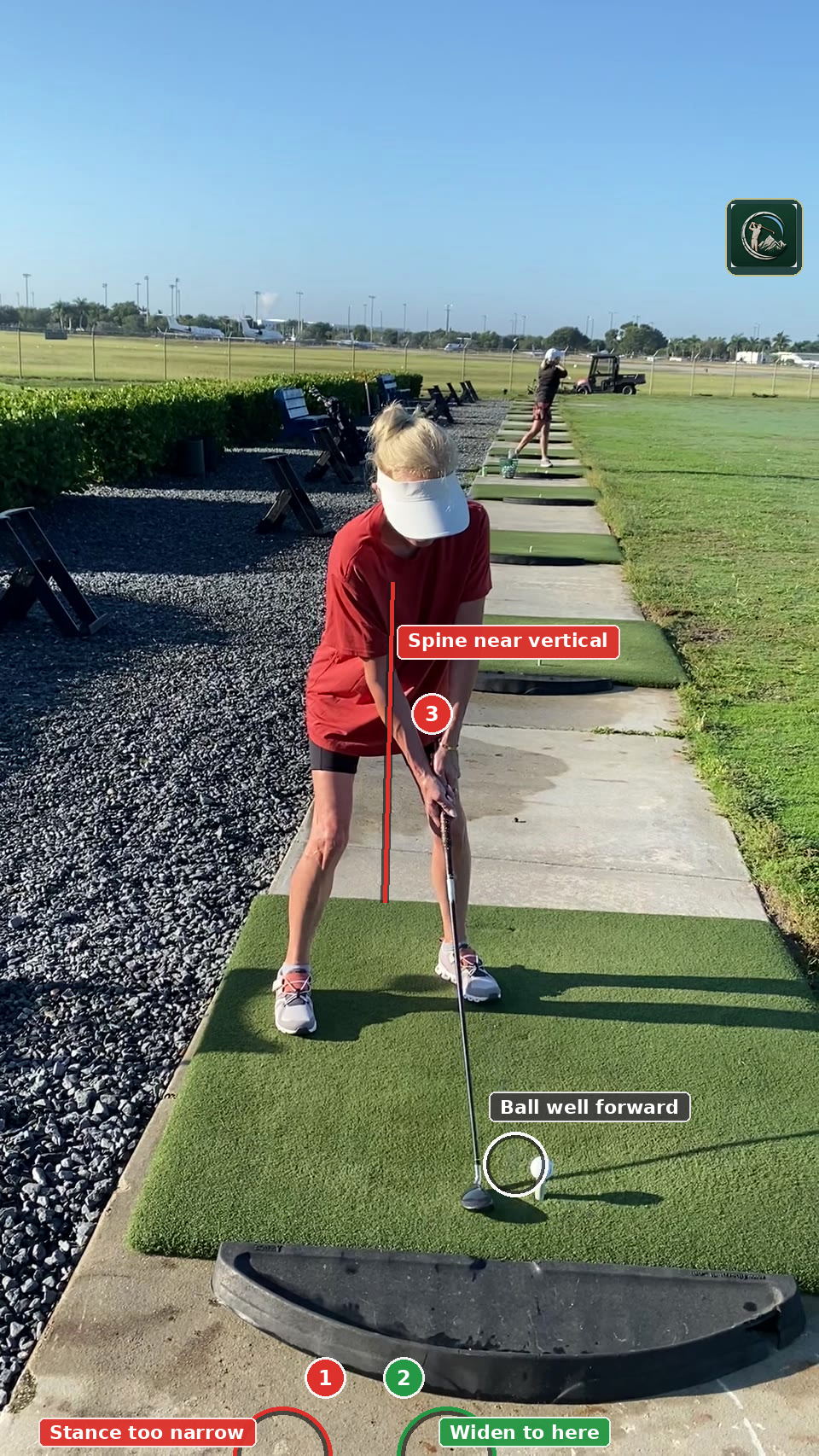 01
Address / setup
- 1stance too narrow
Your insteps sit inside shoulder width for a driver, which gives you nothing to coil against. Widen until the insteps are under the shoulder joints.
- 2widen to here
Move the lead foot out so the base matches driver width and the trail hip has room to turn behind you.
- 3spine near vertical
There is very little tilt away from the target at address with the ball this far forward, so you are set up to hit down on a driver rather than up. Drop the trail shoulder and let the sternum sit behind the ball.
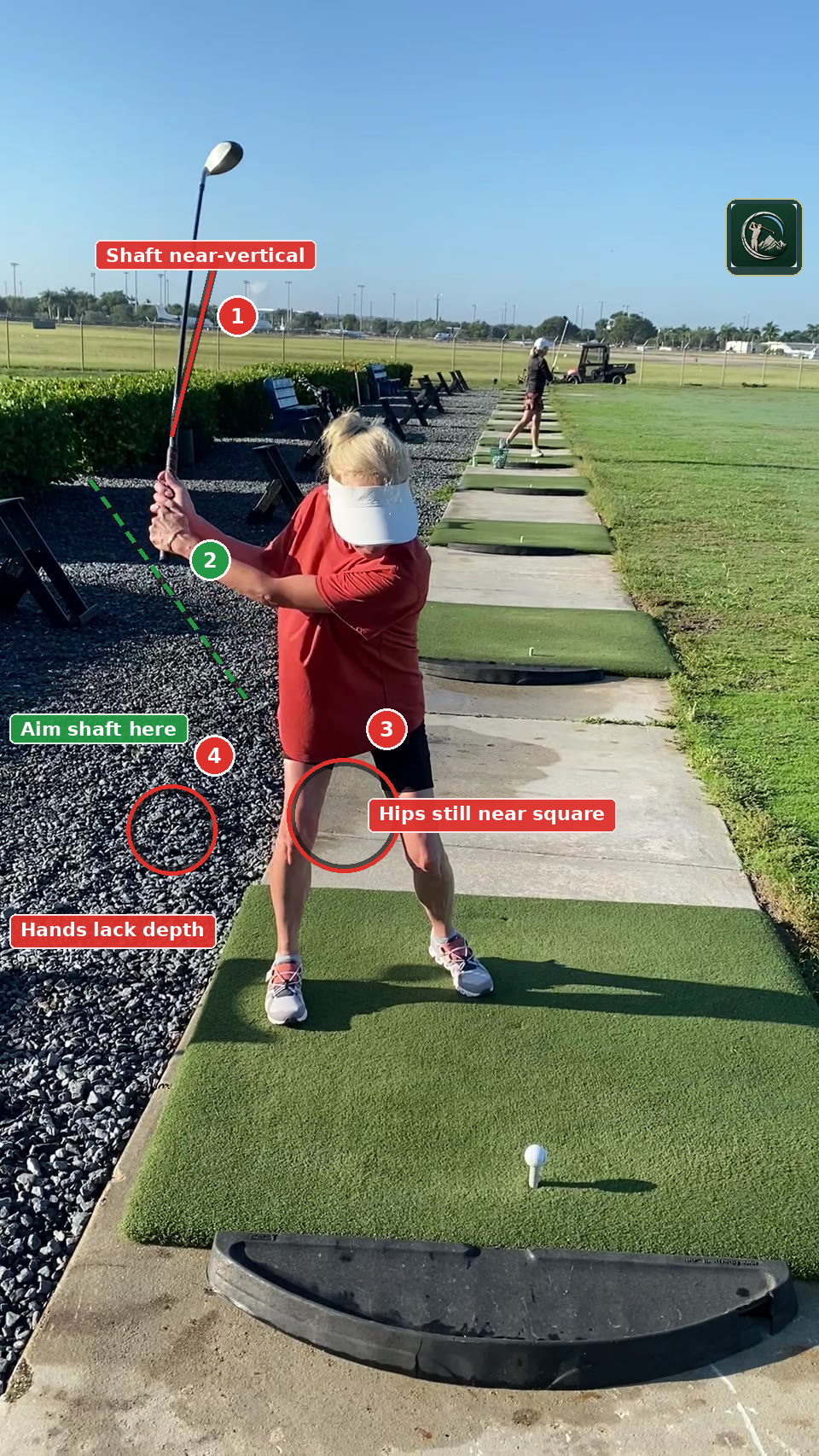 02
Top of backswing
- 1shaft near-vertical
The shaft stands almost straight up at the top instead of lying on a rounded plane — the clearest sign the arms lifted the club rather than the body turning it. This leaves you with height instead of stored coil.
- 2aim shaft here
Target the shaft roughly halfway between vertical and flat, working around behind your trail shoulder. That is where depth and coil live.
- 3hips still near square
The belt line has barely rotated behind you at the top, so the trail hip never gained depth. Without that, the downswing has no ground to push from and the arms have to supply all the speed.
- 4hands lack depth
The hands sit high but stay in front of the chest rather than behind the trail shoulder — height without width or depth. Feel the hands travel around your body, not upward.
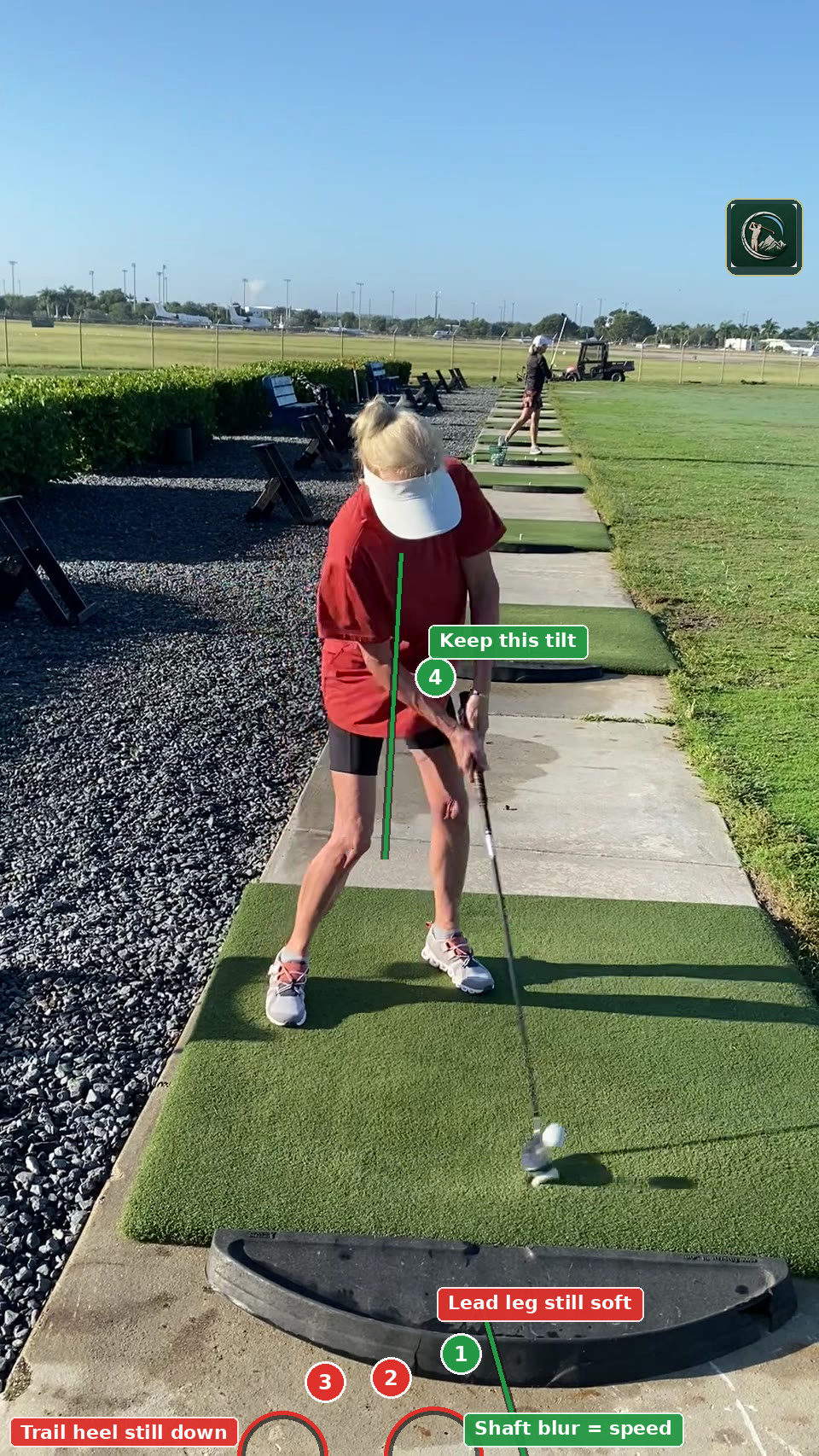 03
Impact
- 1shaft blur = speed
Real acceleration through the strike with the handle leading the head — no throw from the top, no scoop. This is the part of your swing to protect.
- 2lead leg still soft
The lead leg is bending rather than bracing and straightening at the strike, so you have no firm post to rotate against and speed leaks out. Feel that leg straighten as the club arrives.
- 3trail heel still down
The trail heel is only just starting to release as the ball leaves — let the foot come with the turn a fraction earlier so the hips can keep clearing.
- 4keep this tilt
Head and upper body are still behind the ball at the strike — hold that, it is the one thing keeping the low point where a driver wants it.
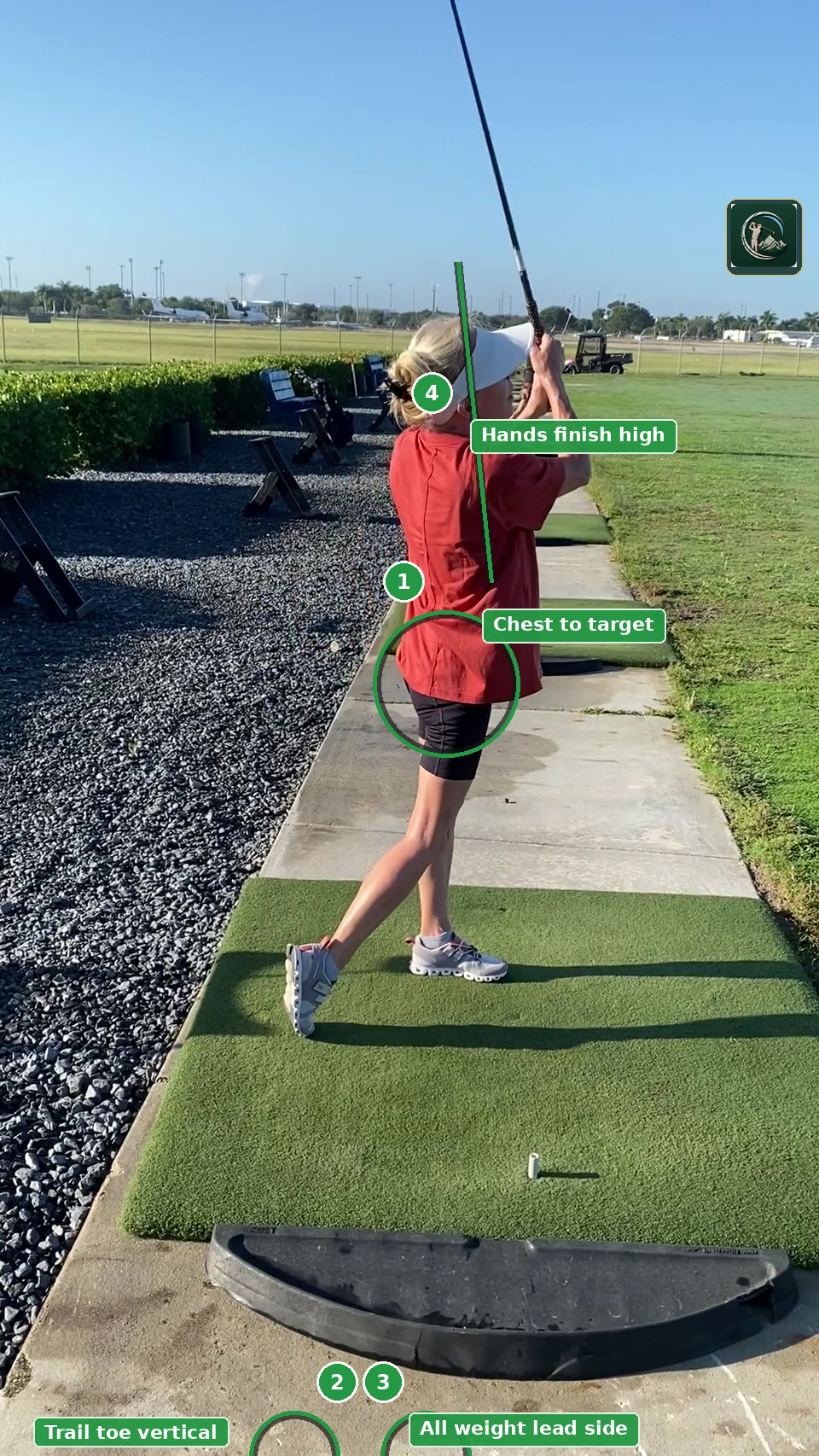 04
Finish
- 1chest to target
Full rotation with the chest and belt facing the target — the hips have completely cleared. This is a tour-standard finish shape.
- 2trail toe vertical
The trail foot has released fully onto the toe with no weight left on it, which is exactly what a complete turn looks like.
- 3all weight lead side
Weight is entirely stacked on the lead leg and you hold it still through the following frames — no stumble, no step to save it.
- 4hands finish high
The arms release fully to a high, tension-free finish, confirming you did not steer the strike.
The complete read.
Each checkpoint is scored from one to five based on visible swing positions.
Setup
10 / 15At frame 2 the forward bend is there but shallow — your chest sits fairly upright over the toes rather than the club-length hip hinge a driver wants, and the knee flex is light. Stance is about shoulder width, acceptable for a driver but not the wider base that supports a big turn. The arms are the best part: they hang cleanly beneath the shoulders with the handle low and relaxed.
Feet and hips read as one line down the mat and the shoulders roughly match. The ball position is the problem: with the ball at roughly x=630 and your sternum at about x=470, the ball is forward, but at frame 2 there is almost no spine tilt away from the target — you look level rather than tilted behind the ball, which is what forces the steep, downward hit later. The still, organized moment before the takeaway is exactly right.
The hands look unified on the handle at frames 0-2 though the camera hides the face and grip strength enough that I can only call it neutral-looking, not confirmed. Forearms are soft and connected in front of the chest, the hands hang comfortably under the chin with good space, and there is no visible squeezing or regripping. Nothing to change here.
Backswing
6 / 15By frame 3 the hands have moved noticeably while the chest has barely turned — the club is being picked up by the arms rather than moving away in one piece with the torso. The clubhead is off-frame to the left so I cannot judge whether it stayed outside the hands. The lower body stays quiet, which is good, but the wrists hinge abruptly early rather than setting progressively as the arms rise.
At frames 6-9 the shoulders have turned perhaps 60-70 degrees at best and the trail hip never gains depth — the belt line stays close to square while the arms climb. The head stays reasonably centered, which is a credit. But the arms are lifted almost straight up rather than swinging around the body: at frame 6 the shaft points near-vertical at the sky while the hands sit no higher than the shoulder. That disconnect between arms and turn is the root fault in this swing.
The shaft at frames 6-9 stands almost straight up rather than lying on a rounded plane halfway between vertical and flat — a textbook arm lift. The hands finish over the trail shoulder but with no depth behind the chest, so there is width in the wrong direction. The lead arm holds its structure and the wrists support the club, which is the one thing keeping this workable. The top looks lifted, not loaded — the downswing cannot start from the ground because nothing is coiled.
Downswing
6 / 10Between frames 9 and 10 there is a visible move into the lead foot and the lower body does start the change of direction rather than the shoulders spinning first — credit for that. But from a vertical shaft there is nothing to shallow: the club stays steep coming down and arrives at the ball on a descending, arm-driven path. Worse, compare head height at frame 2 with frame 11 — the head has dropped several ruler units and the torso has moved toward the ball line, a dive rather than a held postur
The pelvis does not clearly lead — at frame 11 the belt line is barely ahead of the chest, so the chest and arms are arriving together and the hands must supply everything. The trail heel is releasing by frame 12, which is correct. Wrist angle is largely spent by the delivery zone because the steep top gives you nothing to hold. Rotation does keep flowing past the ball into frames 12-13 rather than stalling, and that is why the release looks as free as it does.
Impact & Finish
7 / 10At frame 11 the hips are only slightly open — the belt line still points close to the ball line while your chest is nearly there with it, meaning the arms deliver the club rather than the body. Weight has shifted to the lead side and the lead leg is bracing. The head, however, has dropped and moved toward the ball versus address, so the spine tilt behind the ball is lost — that is the cause of inconsistent driver contact. Hands look level with the head of the club through the strike, not scooped
This is the best part of the swing. By frame 18 the chest and belt buckle face the target with the hips fully cleared, the weight is entirely on the lead leg, and the trail foot is up on a vertical toe. You arrive balanced and hold it still through frames 17-19 with no stumble or step. The one reservation: the effort you put into the down-move outruns the coil you built, so the motion looks harder than the positions justify.
Three drills.
One direction.
Build the motion slowly, then add speed only when it stays organized.
Build the shoulder and trail-hip turn that is currently missing, so the arms stop doing the backswing's job.
Cross-arm chest turn against a braced trail leg
- Fold your arms across your chest, take your driver setup posture, and place a club or alignment stick along the outside of your trail foot.
- Turn your chest to the top without letting the trail hip bump into the stick — feel the trail hip move behind you and gain depth instead of sliding.
- Hold the top for three seconds and check in a mirror or on video that your lead shoulder has passed over the ball position.
- Repeat ten times, then hit five half-speed drivers trying to reach that same chest position before the arms rise.
Replace the near-vertical arm lift at the top with a rounded, on-plane shaft and hands with depth behind the chest.
Shaft-on-plane top check
- Take your address, then swing to the top in slow motion and freeze.
- Video from down the line and compare your shaft to a line drawn up through the ball and your shoulders — the shaft should sit roughly halfway between vertical and flat, not pointed at the sky.
- Adjust by letting the hands travel around and behind the trail shoulder rather than upward; the lead arm should feel like it is turning across your chest, not lifting.
- Do ten slow reps, then three swings at half speed keeping the same top before returning to full speed.
Stop the drop and drift of the head into impact so the spine tilt behind the ball is retained.
Head-height wall drill
- Set up with the crown of your head lightly touching a wall or the shaft of a club held by a friend directly above you.
- Make slow backswings and downswings keeping constant contact — no pulling away and no pressing up into it.
- Progress to three-quarter speed swings hitting a tee off a mat, checking on video that your head is at the same height at impact as at address.
- Finish each set with two full drivers keeping the same feel.