
Goldberg
This is a swing driven almost entirely by the arms and hands from a passive, over-wide base. At address you are bent more from the waist than the hips, with the handle sitting high and the hands crowded in close to the thighs, and that posture sets up everything that follows: the backswing tops out with the hands barely above chest height at frame 7, the trail side stays stacked over the trail foot instead of coiling and shifting, and the club never gets to a loaded top. From there you throw the arms at the ball and the body follows late — by frame 8 the ball is gone but the hips are only just starting to open and the trail heel is still bearing weight. The genuine credit is at the other end: you do keep swinging through, and the finish at frames 11-13 is tall, turned toward the target with the trail foot released and no stumble, which tells me the athletic ability is there and it is the sequence and the base that are costing you, not effort or balance. Fix the address posture and make the ground start the downswing, and the hands will stop having to supply the power.
Swing video
What’s working
The finish is genuinely well organized: at frames 11-13 the chest is facing the target, the trail foot has released to the toe, and the position is held still for several frames without a stumble or step — that is a balanced, committed pass through the ball, not a guided one.
Tempo is sensible and unhurried — roughly four frames up (4-7) to about one and a half down (7-8) — so the motion accelerates into the ball rather than being decelerated or steered.
Head and upper-body height stay reasonably constant from address through frame 8: there is no big stand-up or dive at the ball, which is why you find the middle of the mat consistently.
Highest priorities
- 1
Rebuild the address posture: at frames 0-2 the bend is coming from the waist with the chest rounded and the hands crowded in tight to the thighs. Hinge from the hip joints, let the handle drop and hang under the shoulders, and narrow the stance — right now the feet are wider than shoulder width for an iron, which locks the hips and turns the swing into an arms-only lift.
- 2
Make the backswing a body turn, not an arm lift. At frame 7 the hands are only chest-high and the trail hip has barely moved behind you — the shoulders never get near a full coil, so there is nothing stored to deliver. Turn the chest and let the trail hip work back and deep before the arms do anything.
- 3
Start the downswing from the ground. Between frames 7 and 8 the arms fire first while the trail heel is still loaded and the hips are square — the body is arriving after the ball is gone. Shift into the lead foot and open the pelvis first so the hands become passengers rather than the engine.
Four positions that shape the swing.
Annotations point only to features visible in the selected frames.
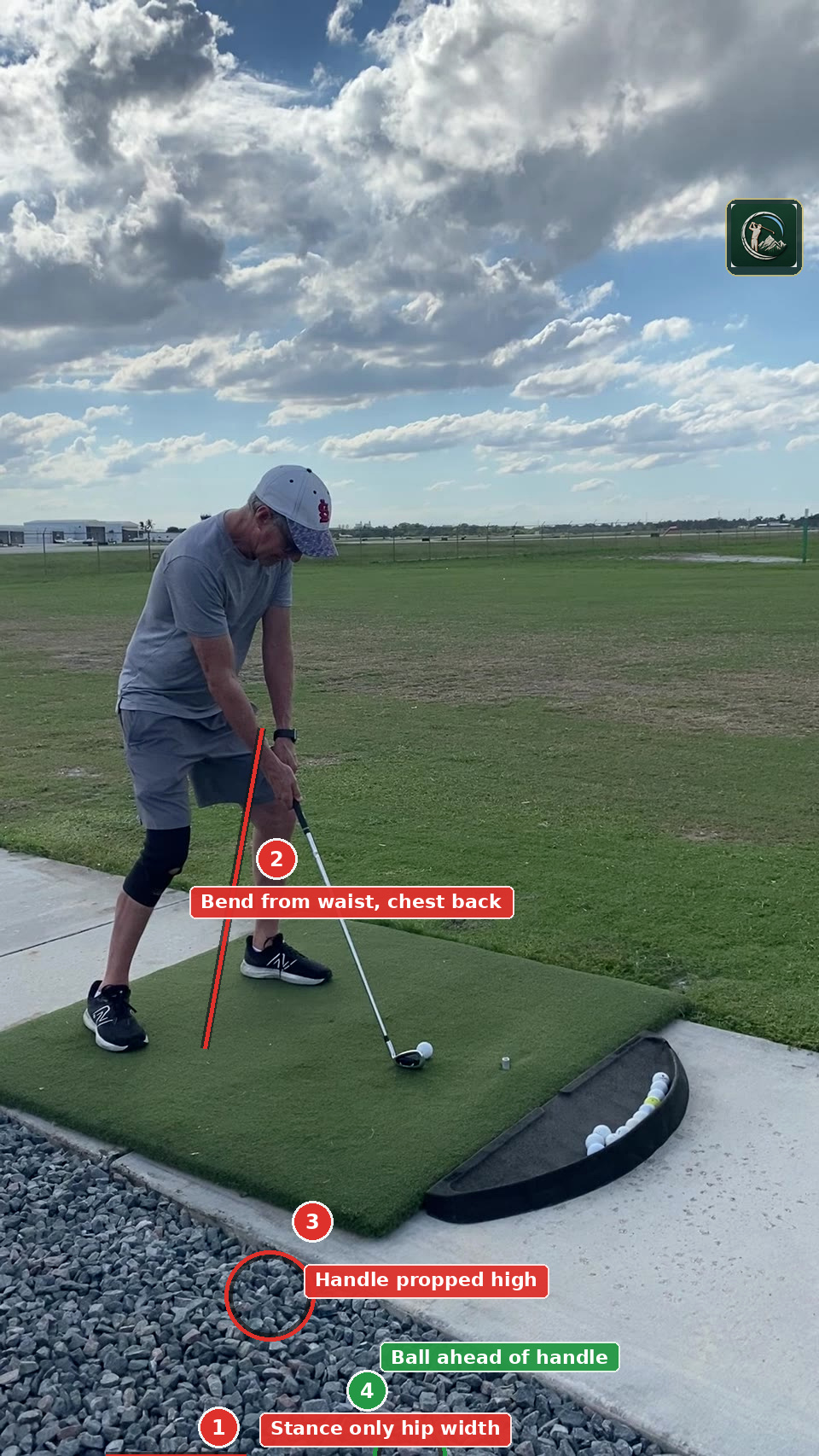 01
Address / setup
- 1stance only hip width
The insteps are barely wider than the hips at frame 1, which is too narrow to support a full-swing club and encourages the trail-side slide you see later. Set the feet closer to shoulder width for a stable base.
- 2bend from waist, chest back
The forward bend is shallow and rounds at the waist rather than folding at the hip joints, so the chest sits behind the toes instead of over them. Push the hips back and keep the chest tall to create the bend from the hips.
- 3handle propped high
The hands are crowded up against the thighs with the trail arm straightened rather than hanging softly under the shoulders. Let the arms hang so the grip end drops away from the legs - a propped handle here makes the takeaway a hands-first lift.
- 4ball ahead of handle
The ball sits forward of the hands with almost no shaft lean at address, so the handle is not leading the clubhead. Move the ball just ahead of center and set the hands slightly ahead of it.
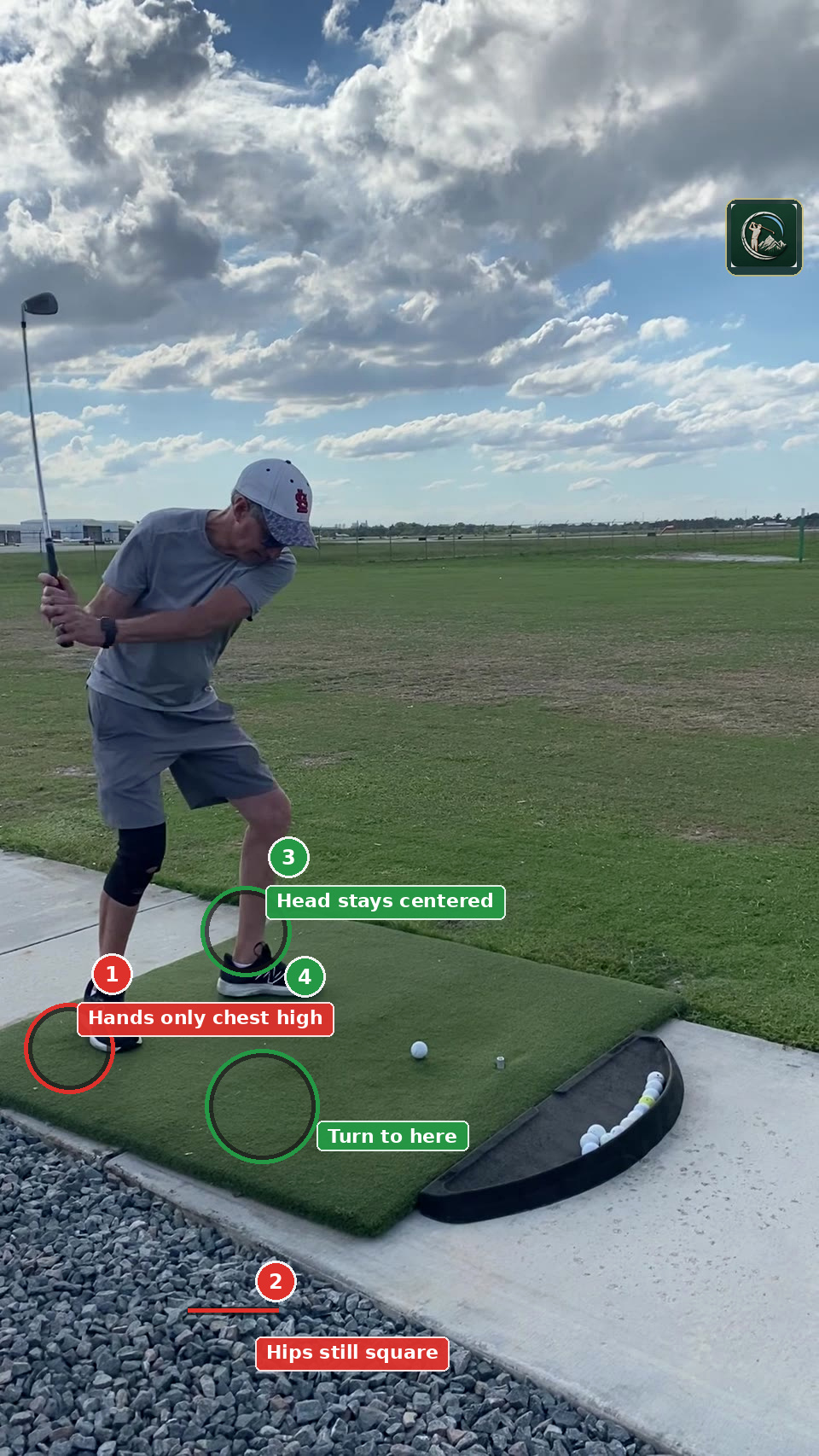 02
Top of backswing
- 1hands only chest high
At the top the hands barely reach chest height and sit well short of over the trail shoulder — there is almost no width or depth behind the chest, so there is nothing stored to deliver. The hands should finish high and behind the trail shoulder.
- 2hips still square
The belt line has hardly rotated: the trail hip has not turned behind the body, so the arms have lifted the club while the pivot stayed home. Turn the trail hip pocket away from the ball and the shoulders will follow.
- 3head stays centered
Good — no sway off the ball and no dip through the backswing. Keep this while you add real hip turn.
- 4target: turn to here
Aim to feel the trail hip work back to about this depth with the chest coiled near 80-90 degrees, so the downswing can start from the ground instead of a rescue move with the arms.
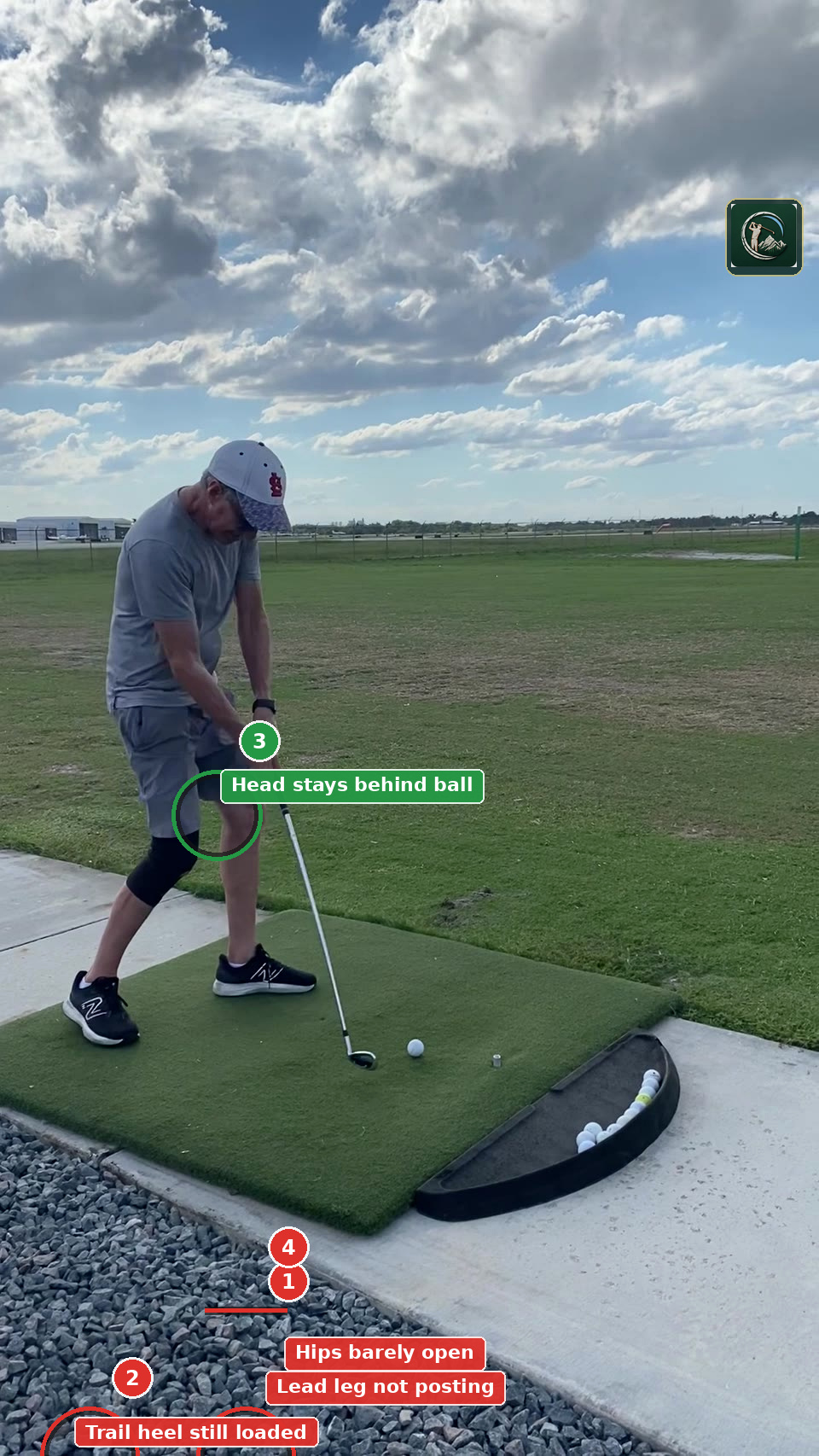 03
Impact
- 1hips barely open
The ball is already gone and the belt line is still close to square to the target — the pelvis trailed the arms instead of leading them, so the hands had to supply all the speed. The hips should be clearly open by the strike.
- 2trail heel still loaded
The trail heel is still flat on the mat with weight in it after contact — rotation is not pulling it up. Let the turn peel that heel off the ground rather than pushing from it.
- 3head stays behind ball
Spine tilt is retained and the head has not lunged forward or stood up — this is why contact stays consistent. Keep it.
- 4lead leg not posting
The lead leg is not bracing or straightening to accept the shift; weight is still split between the feet. Work on posting into that lead side within whatever the knee brace allows.
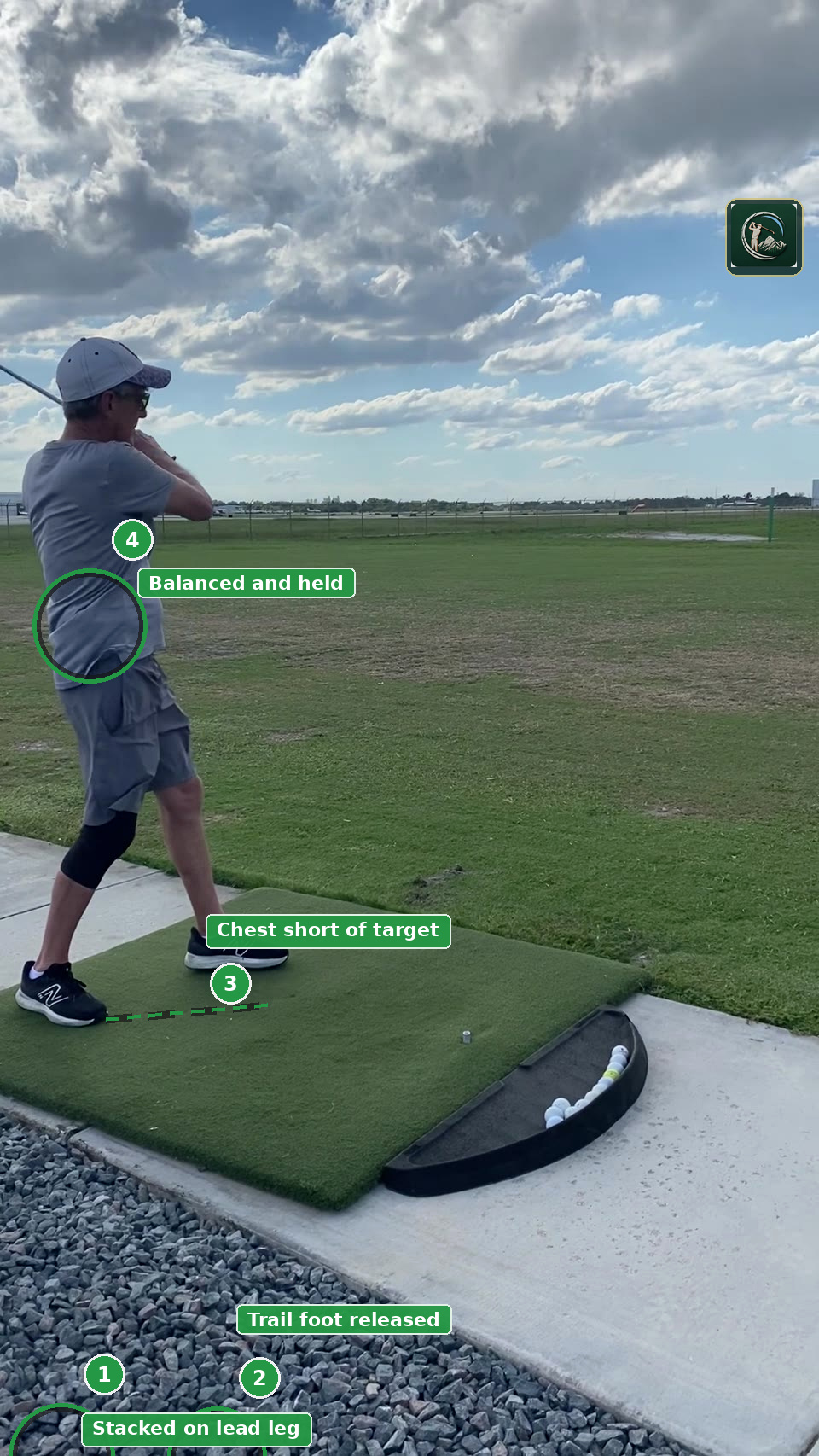 04
Finish
- 1stacked on lead leg
Weight is fully on the lead leg at frame 12 with the leg supporting the whole body - a tour-quality finish detail worth protecting.
- 2trail foot released
The trail foot has released cleanly onto a vertical toe, showing the rotation carried through the strike rather than stalling.
- 3chest short of target
The chest and belt buckle stop just short of facing the target, which traces back to the shallow backswing turn - there was less to unwind. More trail-hip depth going back will let the finish complete fully.
- 4balanced and held
The position is held still for a beat across frames 12 to 14 - no stumble or step to save it. Balance like this means tempo is not the problem; the pivot is.
The complete read.
Each checkpoint is scored from one to five based on visible swing positions.
Setup
8 / 15At frames 0-2 the forward bend is coming largely from a rounded waist rather than a clean hip hinge, and the chest sits behind the toes rather than over them. The stance is noticeably wider than shoulder width for this club, which sounds stable but actually pins the hips and forces an arms-only turn. Knee flex is acceptable and pressure looks mid-foot, but the handle is propped high and the hands are jammed in close to the thighs instead of hanging freely under the shoulders.
From this face-on angle the feet, knees, and hips look coherent and the shoulders roughly match them, and the setup is genuinely still across frames 0-3 with no fidget or foot drift. Ball position is playable — just forward of center for the club — but the wide stance makes it read more forward relative to the lead heel than you intend, which is one more reason to narrow the base.
The grip looks unified and reasonably neutral in frames 0-2. The problem is the connection: the trail elbow and forearms are working in tight and slightly rigid rather than soft in front of the chest, and the hands sit crowded against the lead thigh rather than hanging roughly under the chin with space to swing. Get the handle further from the body and the arms will have somewhere to go on the way back.
Backswing
7 / 15Frames 4-5 show the hands and club moving away noticeably ahead of the chest — this is a hands-and-arms pickup, not a one-piece move, which is why the club is already deep left of the body while the torso has barely rotated. Clubhead position relative to the hands and face angle cannot be judged from face-on. The lower body stays quiet with no sway off the ball, and the wrists do set progressively rather than snapping.
By frame 6-7 the shoulders are well short of a full coil and the trail hip has essentially not turned behind you — the hips stay square while the arms lift, which is the single biggest power leak on this card. Credit where it is due: the head and spine stay centered without a slide or dip. But the arms are out-running the pivot rather than swinging in sync with a turning chest, so the club gets carried up by the hands instead of around the body.
Shaft plane at the top cannot be assessed from face-on. What is clear at frame 7 is that the hands only reach roughly chest height and sit well short of over or behind the trail shoulder — there is no width or depth behind the chest. The lead arm keeps enough structure and the wrists support the club, but the position does not look loaded: with the trail heel still flat and the hips square, the only way down is with the arms.
Downswing
6 / 10Comparing frames 7 and 8, the arms and club drop well before any visible pressure move into the lead foot, and the change of direction is initiated by the upper body rather than the ground. Shaft steepness through transition is not readable from this camera. The redeeming feature is that posture and head height hold — there is no early stand-up or dive at the ball, so the low point stays repeatable.
At frame 8 the ball is already gone and the belt line is still close to square while the chest has already unwound — the pelvis is not leading, it is trailing. The trail heel is still carrying weight through the strike instead of being pulled off the ground by rotation, and the wrist angles look largely spent before the delivery zone. Rotation does at least keep flowing into frames 9-11 with no stall-and-flip rescue, which is the one thing keeping this item off the floor.
Impact & Finish
6 / 10Frame 8 is the closest available frame after the strike and it shows hips only marginally open with the chest doing the work. Weight is still spread between the feet rather than stacked into a bracing lead leg — the knee brace is likely part of why the lead side is not posting. The head does stay behind the ball with spine tilt retained, which is a real positive. Exact shaft lean at the moment of contact falls between sampled frames and is not judgeable.
This is the best part of the swing. By frames 11-13 the chest and belt buckle are facing the target and the trail foot has released onto the toe, and the position is held dead still across three sampled frames — no stumble, no step, no save. Full credit for that. It stops short of top marks only because the hips have not cleared fully and some weight remains on the trail side; a real pivot in the backswing would let this finish be as good as it looks.
Three drills.
One direction.
Build the motion slowly, then add speed only when it stays organized.
Replace the waist slump at address with a genuine hip hinge and free-hanging arms.
Chair-back hip hinge with a club across the hips
- Stand a foot in front of a chair, hold a club across the front of your hips, and push your hips back until they touch the chair — feel the fold at the hip joints, not the belt line.
- Add knee flex, let the arms drop straight down until the hands hang under the chin with a hand's width of space from the thighs.
- Narrow the feet to just inside shoulder width for a mid-iron, then take five rehearsals and one ball without changing the hand height.
Turn the trail hip back and deep so the backswing is a coil, not an arm lift.
Trail-hip-behind-you turn drill
- Set up with a club shaft or alignment stick vertically just outside your trail hip.
- Make slow backswings turning the trail hip away from the stick — the hip pocket should move behind you, not into the stick, while the head stays centered.
- Hold at the top and check that the hands are now over the trail shoulder, higher and deeper than they were at frame 7.
- Hit half-shots keeping that hip-depth feel; distance will feel effortless before it feels fast.
Make the ground and pelvis start the downswing instead of the arms.
Lead-heel step-through sequence drill
- Set up with the lead foot pulled back next to the trail foot, holding a 7-iron.
- Swing to the top, then step the lead foot out to normal width and let that step trigger the downswing — the arms must wait for the foot to land.
- Feel the trail heel being pulled off the mat by the turn rather than pushing off it, and finish with the belt buckle at the target.
- Alternate five step-through swings with one normal swing, keeping the same order of events.